A refinery that learns. A network that gets wiser.
We’re engineering a refinery that responds to the material moving through it. Industrial hardware, machine learning and a connected data record are working towards the same goal: consistent products from variable agricultural feedstock.
01
The Industrial Hardware.Engineered as one system.
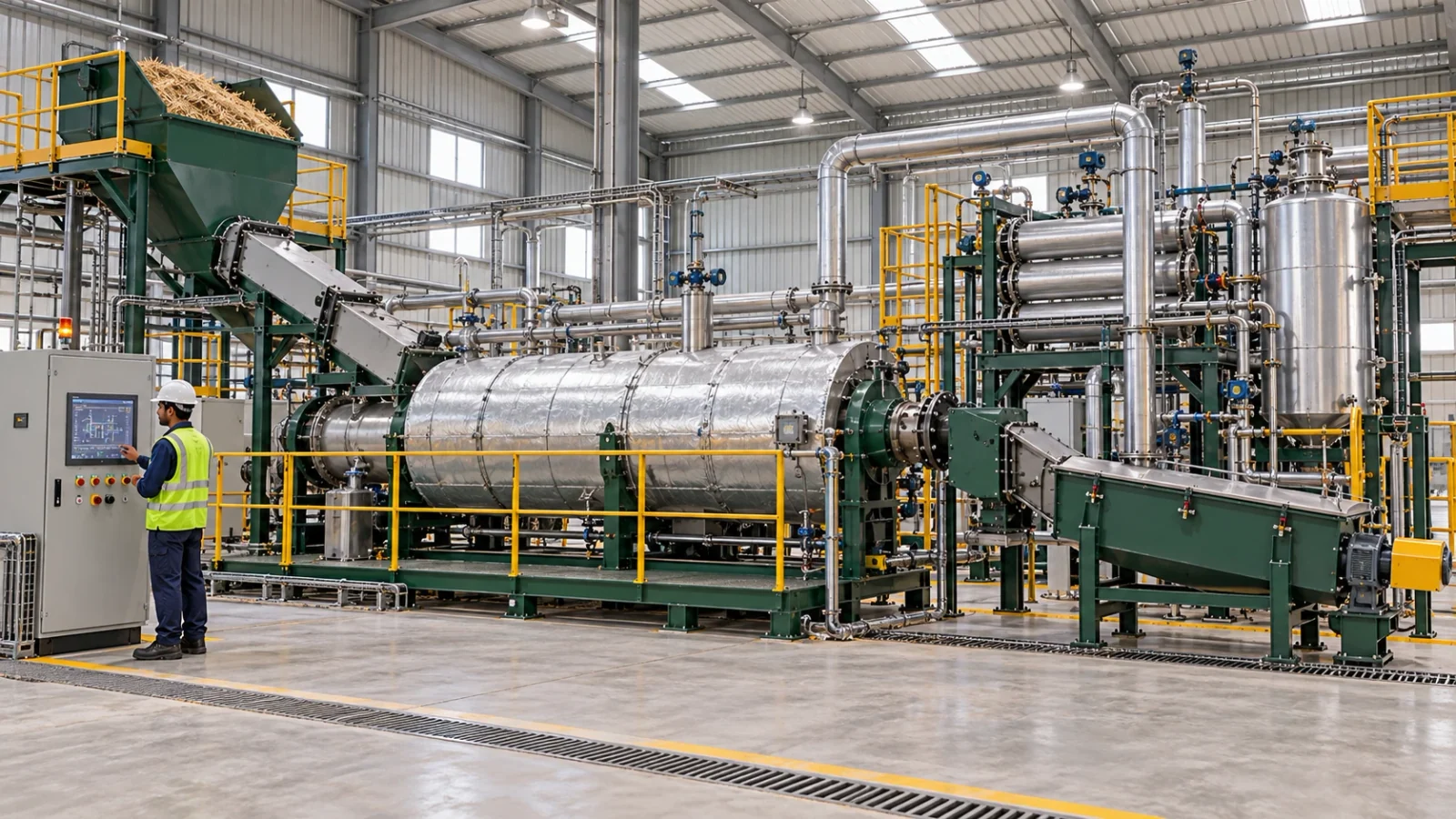
Our industrial biorefinery brings preparation, thermal conversion, fraction recovery and product finishing into one coordinated plant. We’re engineering the connections between these stages as carefully as the equipment within them. Material flow, heat transfer, emissions control and maintenance access all shape a facility designed for continuous production, safe operation and repeatable product quality.
I.
Continuous Conversion
Straw preparation and sealed transfer lead into an indirectly heated, oxygen-limited reactor. Controlled temperature and residence time shape conversion and the resulting char. The mechanical design connects steady material movement with access for inspection and maintenance. Enclosed discharge and cooling protect hot biochar from uncontrolled contact with air.
II.
Staged Recovery
The recovery train follows each fraction into a usable product. Staged cooling separates condensable vapours, while solids handling prepares biochar for grading and finishing. Condensers, separation vessels and dedicated storage keep material streams distinct. Sampling points connect product handling with laboratory checks and the specifications of each market.
III.
Integrated Energy
Non-condensable gas provides a route back into process heat, supported by start-up and backup systems. Heat recovery, gas cleaning and monitored combustion are being designed as a shared utility system. Dust collection, water management and residue handling complete the plant’s environmental controls. Independent interlocks and shutdown protection sit outside the optimisation layer.
THE FLAGSHIP MODULE
Small enough to repeat.Big enough to matter.
We’re engineering our first facility’s plant system around these capacity and output benchmarks. Commissioning and operating evidence will establish achieved performance.
50tonnes/dayStraw input capacity
15,000tonnes/yearAnnual straw input
5,000tonnes CO₂e/yearNet carbon removal
4,000tonnes/yearBiochar
2,400tonnes/yearBio-vinegar
600tonnes/yearTar oil
02
The Intelligent Software.Learning from every run.
Our software connects process models, equipment condition and production history to help operators see what is happening, anticipate a change and choose a response. It is being built to improve product consistency, equipment availability and decisions across the refinery network. Automation remains bounded by operating limits, operator oversight and independent safety systems.
I.
Adaptive Process
Temperature, pressure, oxygen and flow measurements inform models of the plant’s changing state. Soft sensors can estimate properties that cannot be measured continuously, giving operators earlier warning of quality drift. Predictive control then compares possible adjustments against product targets and operating constraints before a change reaches the actuators.
II.
Autonomous Operations
Machine vision, vibration trends and equipment histories can reveal handling problems, fouling or wear before they interrupt production. Our operations layer is connecting anomaly detection with inspection priorities, maintenance planning and guided operator actions. Alarm context and a record of interventions help teams distinguish a developing fault from normal variation.
III.
Network Intelligence
Operating recipes, laboratory results and maintenance outcomes become more useful when refineries can learn from one another. A shared knowledge graph is linking material properties, equipment behaviour and product performance across projects. Versioned models can be compared against local evidence before transfer, allowing proven improvements to travel without treating every catchment as identical.
INDUSTRY 5.0
Physical AI in practice.
01
Sense
Pressure drop, motor current, vibration and heat-duty trends reveal interacting changes over time.
02
Understand
Machine learning helps distinguish normal load variation from a developing restriction or equipment wear.
03
Respond
Flag a targeted inspection or a constrained operating adjustment before the disturbance spreads.
04
Learn
Compare predictions with maintenance findings and refine the model without changing independent safety limits.
We’re developing this control architecture around operator oversight, independent safety systems and measured validation.
03
The Data Layer.From intake to dispatch.
Control signals describe the plant in motion. Production records establish what it has made, moved and consumed. Our data layer connects those views through batch identities and a consistent record of events. This gives operations, customers and carbon reviewers a common evidence trail without losing the detail behind a result.
I.
Traceable Material
Intake weighments, moisture basis, processing batches and dispatch records follow the same material journey. Splits, blends and samples retain links to their parent batches. That lineage lets a product result be traced back to its source and helps reconcile inventory across the plant.
II.
Accountable Operations
Time-stamped readings sit alongside instrument calibration, operator actions and equipment events. Controlled corrections preserve both the original record and the reason for a change. Access permissions and version history make the account reviewable, including when sensors or manual records disagree.
III.
Verifiable Carbon
Laboratory assays, resource use and lifecycle emissions connect production to the carbon account. Sourcing and storage evidence remain attached to the batches they support. Reviewers can follow how measured inputs, deductions and uncertainty lead to the reported net removal, with missing evidence visible.
An auditable digital twin.
We’re assessing a digital twin that mirrors material movements, process events and custody changes, with selected records anchored to a blockchain. Time-stamped hashes and signed handovers could make later alterations detectable and let different parties verify that they are working from the same evidence.
Detailed operating data would remain in controlled records, while the shared ledger could preserve proofs of origin and transfer. This is a potential bridge between Industry 5.0 and Web 3.0 where it adds practical integrity and traceability. A tamper-evident record still depends on sound measurements and independent checks at its source.
04
The Rails Beyond.From sourcing to verified use.
GG Drishti is helping us examine where a project belongs and where all its feedstock comes from. GG Krishi is connecting the material’s final use to the farmer and the field. Together, they are extending the data record beyond the plant gate for robust chain of custody upstream as well as downstream.
GG Drishti
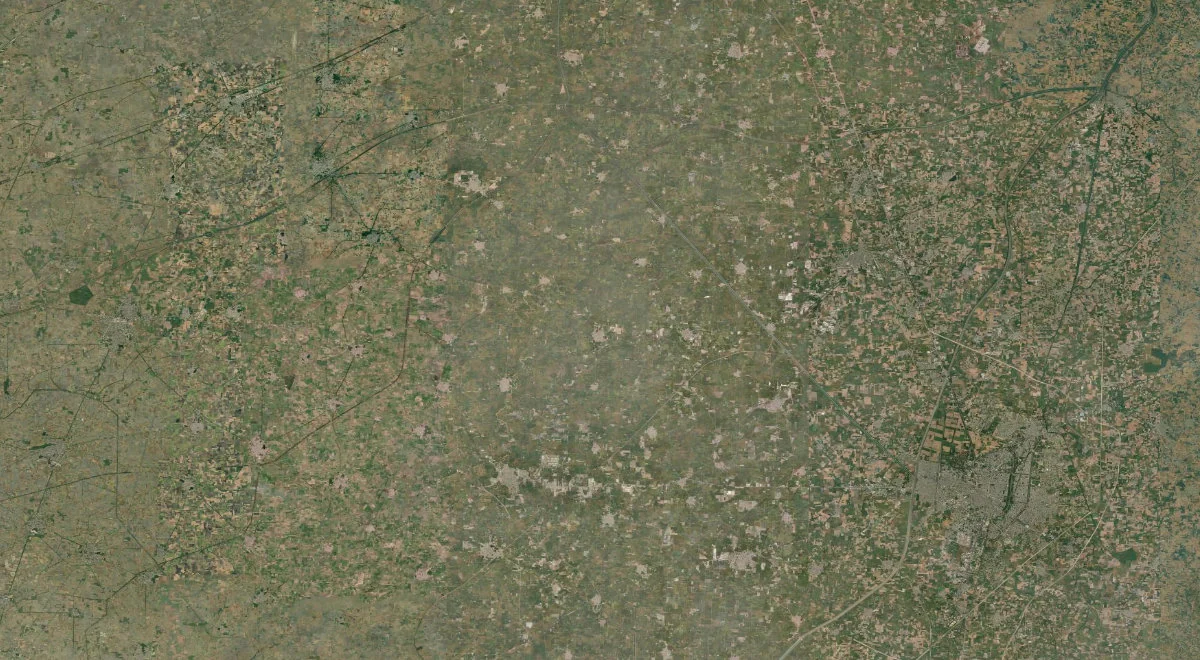
We’re combining satellite imagery and remote sensing with GIS to examine burn history, soil and water stress, and nearby industry. GG Drishti brings these layers into one view, connecting straw supply with environmental need and local product demand. Industry mapping also identifies competing uses for straw, helping us assess feedstock availability and mitigate leakage risk.
GG DRISHTI · CATCHMENT SCREENING
Prospect sites● Burn history□ Industry▨ Soil and water stress
Connect residue burning, ecological urgency and routes to market.
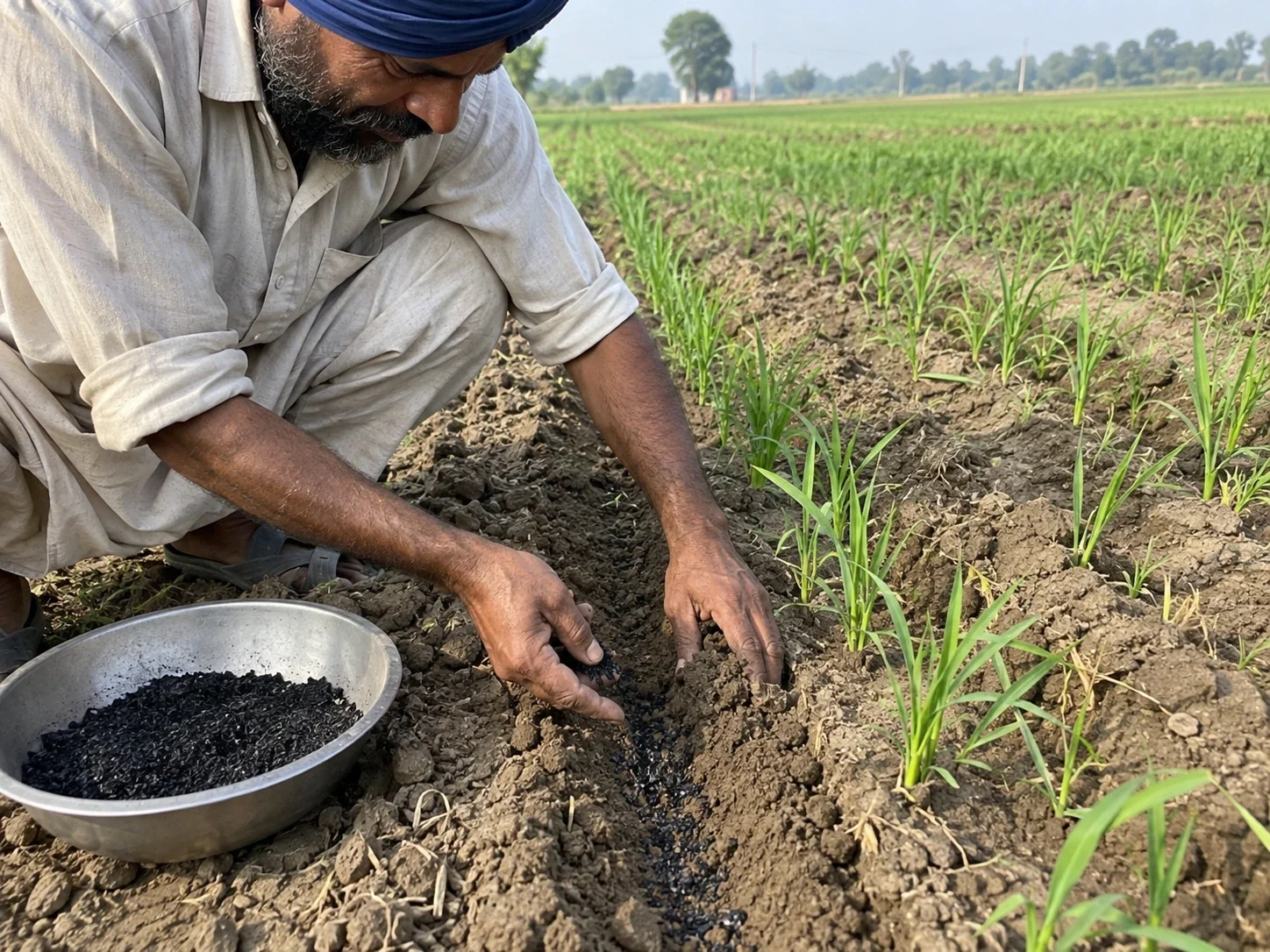
We’ve built an AI-powered WhatsApp chatbot for end-use verification, with vernacular, multilingual conversations that meet farmers in their own language. GG Krishi connects date, time and geo-stamped visual evidence with the farmer’s digital signature, turning a familiar exchange into a traceable application record.
GG KrishiFarmer support
आज
नमस्ते! खेत में बायोचार डालने की फोटो और लोकेशन भेजें।09:41
फोटो भेज दी।
09:42 ✓✓
खेत की लोकेशन
कुरुक्षेत्र, हरियाणा
09:42 ✓✓
धन्यवाद! फोटो और लोकेशन मिल गई हैं। हमारी टीम जाँच करके पुष्टि करेगी।09:43
The GG Laboratory.More to the rice plant than meets the eye.
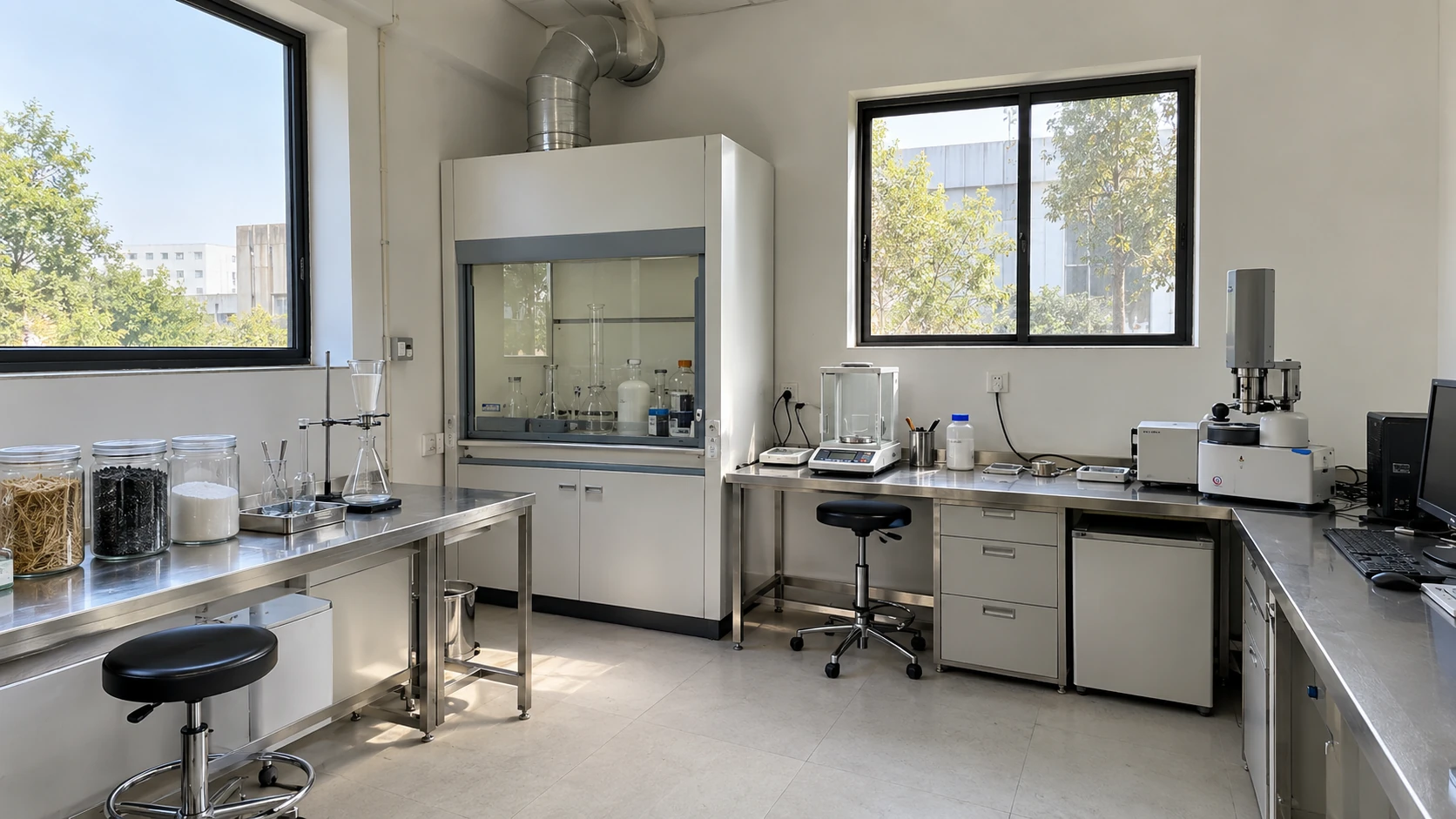
We’re designing an on-site laboratory and downstream chemical pilot skid to work with an ash-richer slipstream of biochar fines. Controlled extraction, solid-liquid separation and precipitation are the route we’re studying for green silica recovery.
Washing, drying and material characterisation complete the experimental loop. The pilot work is examining purity, recovery yield and repeatability alongside reagent reuse, water treatment and residual solids, before a process can move towards larger-scale production.
Advanced materials engineering takes this work beyond separation. We’re studying how controlled purity, particle structure and surface chemistry can turn recovered fractions into materials for demanding industrial and energy-storage applications.
SCIENCE WITHOUT BORDERS
Built in India.Connected to the world.
Hong Kong
We’re pursuing research and development with The University of Hong Kong, connecting conversion chemistry, mineral recovery and electrode testing as we develop technology, process and materials IP.
Amsterdam
Research pathways with the University of Amsterdam are under exploration as we establish a European carbon-market presence, closer to institutional carbon removal and policy developments such as the EU’s Carbon Border Adjustment Mechanism (CBAM).