THE GREEN GOLD PLATFORM

One refinery is a beginning.
A platform changes the scale.

We’re building the technology, operating systems and market relationships that let local projects become a connected industrial network.

Respect each catchment.Replicate the capability.

Straw supply, farmer relationships and product demand are local. The engineering, intelligence and institutional capability behind them can travel.

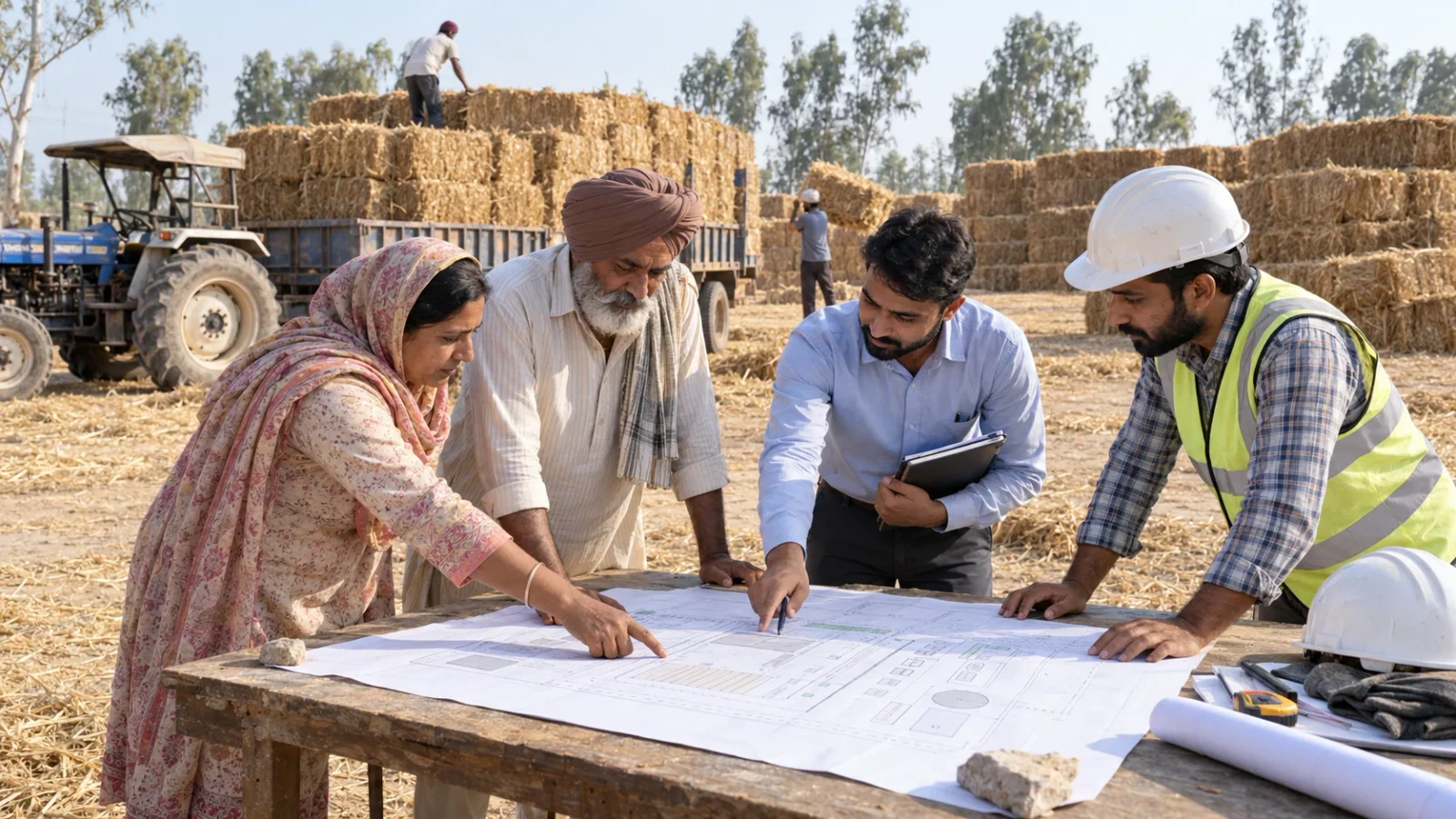
Illustrative scene of farmers and project partners planning straw aggregation in a north Indian village

Distributed assets.Shared enterprise value.

Licensing, franchise and project partnerships are the routes we’re developing to connect the shared platform with local strengths. Different partners bring different opportunities, from ready product channels to nearby feedstock and established farmer networks.

Seed & agri-input companies
Seed and agri-input companies can combine joint-project ownership with offtake of biochar and bio-vinegar. Their agronomic expertise, product development and established distribution channels can bring soil amendments and crop-care products to farmers under familiar brands.
FPOs & PACs
Farmer Producer Organisations (FPOs) and Private Agricultural Cooperatives (PACs) can bring farmer networks and local coordination to joint projects, keeping straw sourcing and product distribution close to the same farming communities.
Rice companies & mills
Existing grower networks and harvest logistics can connect nearby biomass to a jointly held refinery adjoining a mill or other rice industry. That proximity can simplify collection, shared infrastructure and local delivery.

The Bharat Biochar Bloc.

The agricultural movement behind the mission.

The Bloc is taking shape as a not-for-profit forum that brings farmers, agronomists, scientists, industry and public institutions together around responsible biochar use. Its role is to build shared knowledge, public trust and practical adoption alongside the industrial platform. Three areas of work will carry that purpose forward: testing biochar in local conditions, equipping communities to use it responsibly, and bringing field experience into the wider sector conversation.

Evidence in the field.

A programme of local trials, demonstration plots and accessible agronomic guidance is taking shape, so farmers can judge what works in their own conditions.

Capability in the community.

Practical guidance for farmer groups, rural entrepreneurs and extension teams is being shaped in local languages and around existing farm routines.

A voice for the sector.

Researchers, producers and buyers are joining conversations on quality, standards and policy, connecting responsible trade with soil, water and rural livelihoods.

OUR PLEDGEHelp ignite India’s Second Green Revolution, and strengthen the food bowl we share with the world.

THE ECONOMIC AMBITION

A new rural economy.More value from the same harvest.

We’re working towards a network handling 5 million tonnes of straw a year by 2036. Two views show the opportunity: an integrated core business, and the longer-term potential of advanced materials.

$446mIllustrative annual network sales · 2036

This is the illustrative gross merchandise value (GMV) of core materials and carbon removal across the network. It excludes potential revenue from technology sales and licensing, process IP, software, operating services and ancillary platform income.

$80m

Biochar

1.25 million tonnes/year

$103m

Bio-vinegar

800,000 tonnes/year

$38m

Tar oil

200,000 tonnes/year

$225m

Carbon removal

1.5 million tonnes CO₂e/year

THE ADVANCED MATERIALS OPPORTUNITY

What if the whole harvestwent further?

We’re examining what the same 5 million tonnes of annual straw input could become if all of it went into one advanced-material route. Illustrative network sales are as follows. Each case uses the full feedstock separately, with an assumed finished yield and selling price.

Silicon-carbon composite

$2.86bn/year
Annual material output
286,000 tonnes
Assumed selling price
$10/kg

7% silica recovery, followed by 70% recovery of its contained silicon into a finished composite of 40% silicon and 60% carbon.

Hard carbon

$1.95bn/year
Annual material output
650,000 tonnes
Assumed selling price
$3/kg

13% finished-material yield from dry straw, after purification and heat treatment.

Activated porous carbon

$1.80bn/year
Annual material output
450,000 tonnes
Assumed selling price
$4/kg

9% finished-material yield from dry straw, after purification and activation.

These are alternative illustrations, not a forecast or additive revenues. We’re using dry-feedstock assumptions informed by published studies, not measured Green Gold yields or customer quotes. Each case assumes all output qualifies and sells. Costs and other product or carbon-credit revenues are excluded.

Sources and assumptions

Prove it in demanding terrain.Take the learning further.

Rice grows across continents, and many regions face similar challenges with its residues. We aim to take our biorefineries into those landscapes and extend the model to other crop residues, including those already available within the Indo-Gangetic Plain. A feedstock’s existing use, desired products, materials opportunity and carbon removal potential will guide that choice. For rice straw, these are the next summits we see across the world:

Southeast Asia

The Transboundary Haze Belt makes smoke a shared regional burden. Rice-growing deltas offer concentrated residues and industrial demand. Local burning sources and collection economics determine the fit.

Nile Delta

Egypt’s seasonal “Black Cloud” gives crop-residue burning a familiar name. The Delta’s rice landscape offers a focused setting for collection, local materials markets and cleaner harvest seasons.

China’s rice belts

Large paddy economies meet established manufacturing and battery supply chains. Feedstock competition, local regulation and product qualification shape the opportunity.

South America

Brazil and Uruguay’s rice economies connect concentrated production with agricultural and industrial markets. The model must fit their residue practices, logistics and local needs.

Italy’s Po Valley

Europe’s rice heartland brings a concentrated crop economy close to demanding industrial customers. Circular materials and verified carbon create a route to test the platform in a different market.

Australian rice belts

The Murray and Murrumbidgee rice-growing regions combine irrigated agriculture with established milling and grower networks. Local straw logistics, water-conscious farming and industrial markets offer a distinct setting for circular materials and durable carbon removal.

Advancing partnershipsfor the goals.

Sustainable Development Goal 17: Partnerships for the Goals

We’re building market traction with carbon-market and verification partners, agri-input businesses, and customers across infrastructure and energy. Some collaborations have begun, while other conversations continue to explore where our materials and technology can meet a shared need.

Carbon markets & verification

In collaboration with

Agriculture, infrastructure & energy

In conversation with

Punjab Agro
Haryana Agro
UPL India
DLF
NHAI
NTPC
IndianOil

Your local strength.Our shared next chapter.

A site, a supply network, a customer base or the capital to build. Let’s find where you fit.

Ambition needsexperience behind it.

Meet the people